Porcelain slabs beat engineered stone on heat and UV tolerance; engineered stone wins on edge work, repairability and a solid material feel porcelain's thin veneer can't match. Chipped porcelain shows its body and can't be polished out; engineered stone repairs invisibly. For worktops, quartz remains the safer daily surface; porcelain earns outdoor kitchens and facades.
Construction: solid vs veneer
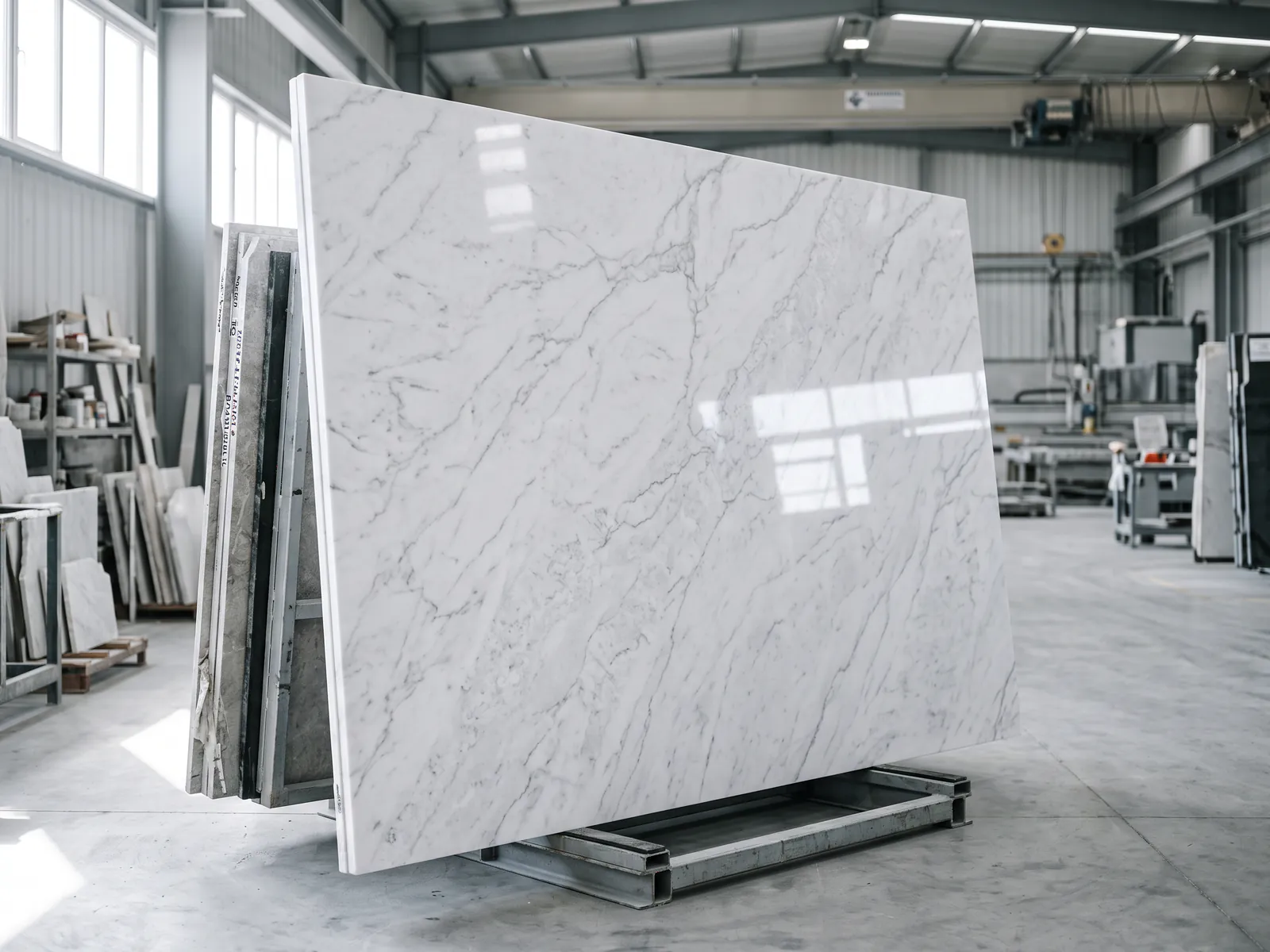
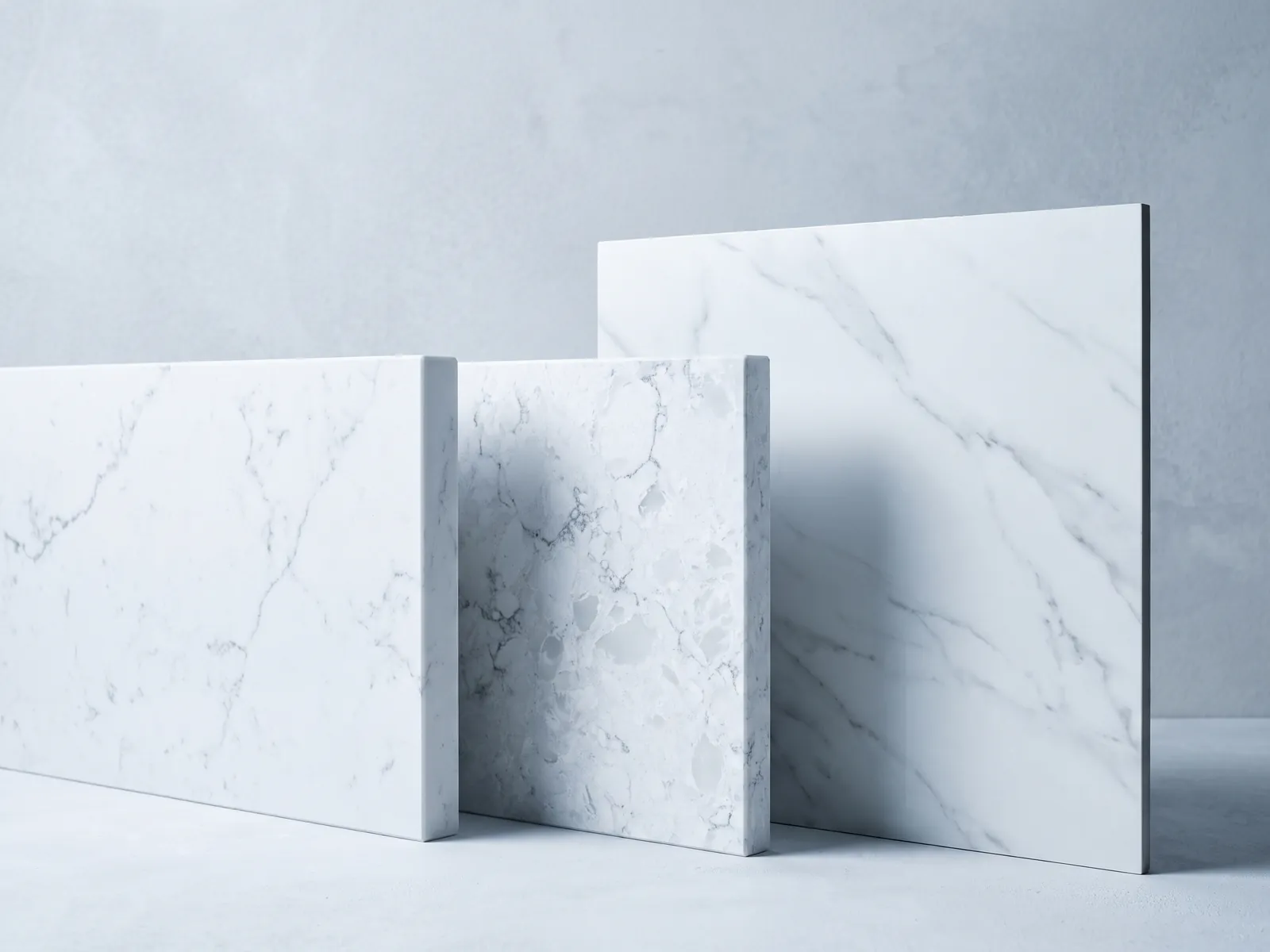
The materials are built on opposite philosophies. Engineered stone, quartz and engineered marble alike, is solid through its 20-millimetre body: the surface you see is the material all the way down, which is why edges polish from the same stock and damage grinds out. Porcelain slabs are ceramic technology: a dense fired body, typically 6 to 12 millimetres thin, carrying its marble look as a printed and glazed surface layer, with large formats and light weight as the reward.
That construction difference drives everything downstream. Porcelain's pattern is skin-deep, so a chip exposes the different-coloured body beneath; engineered stone's pattern is the body. Porcelain's thinness enables facades and furniture skins; engineered stone's mass gives worktops their reassuring solidity and thud. Neither philosophy is wrong, they are different tools, and the complete quartz guide and engineered marble guide cover the solid family's own internal choices before this cross-family decision.
Heat and UV: porcelain's win
Where temperature and sunlight rule, porcelain rules. Fired above a thousand degrees, its body is indifferent to any pan a kitchen can produce: direct hot cookware, the single genuine weakness of resin-bound surfaces, is a non-event. UV stability follows the same logic, ceramic pigments do not shift in sun, which is why porcelain owns applications engineered stone must refuse: outdoor kitchens and barbecue runs, facade cladding, pool-adjacent counters, full-sun terraces.
Engineered stone's resin caps it around 150 degrees and indoors, as covered in the quartz heat guidance; prolonged Gulf sun will eventually warm-shift its binder. In the UAE this split is not academic: summer roof terraces and outdoor majlis kitchens are precisely where specifying the wrong family costs a surface in two seasons. The honest rule: outdoors and hot-works zones, porcelain without debate; everywhere else, the comparison continues on the next criteria, where the veneer starts paying for its virtues.
Edges, mitres and repairs: stone's win
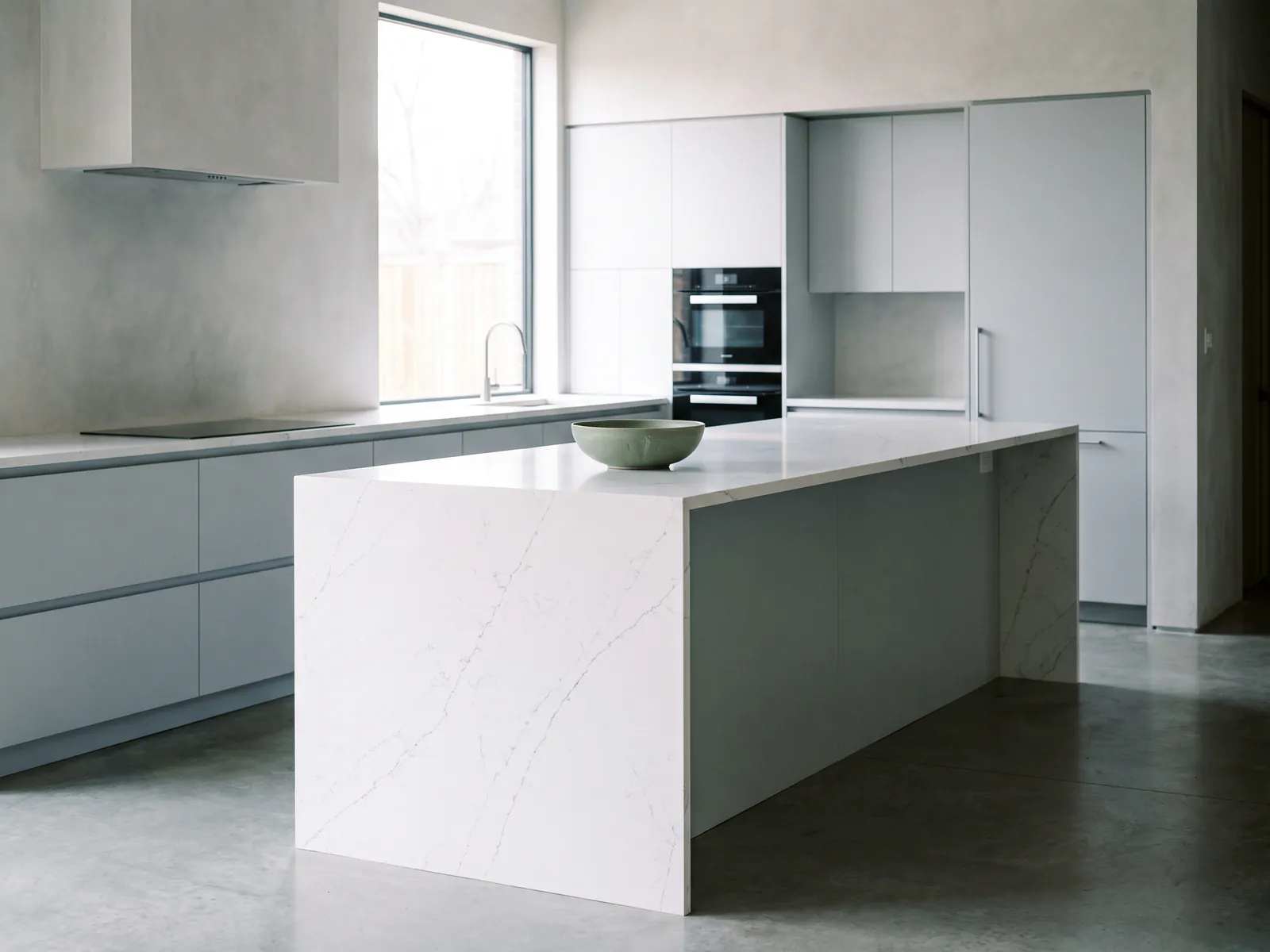
Fabrication is where solidity collects its dividend. Engineered stone edges machine and polish from the body itself, pencil rounds, bevels, bullnoses, and mitred waterfall corners where the pattern flows over the edge convincingly, since the material is the pattern. Damage tells the same story: chips fill and polish invisibly, scratches and dulling grind out locally, and a decade-old top can be refreshed because there is material to work with.
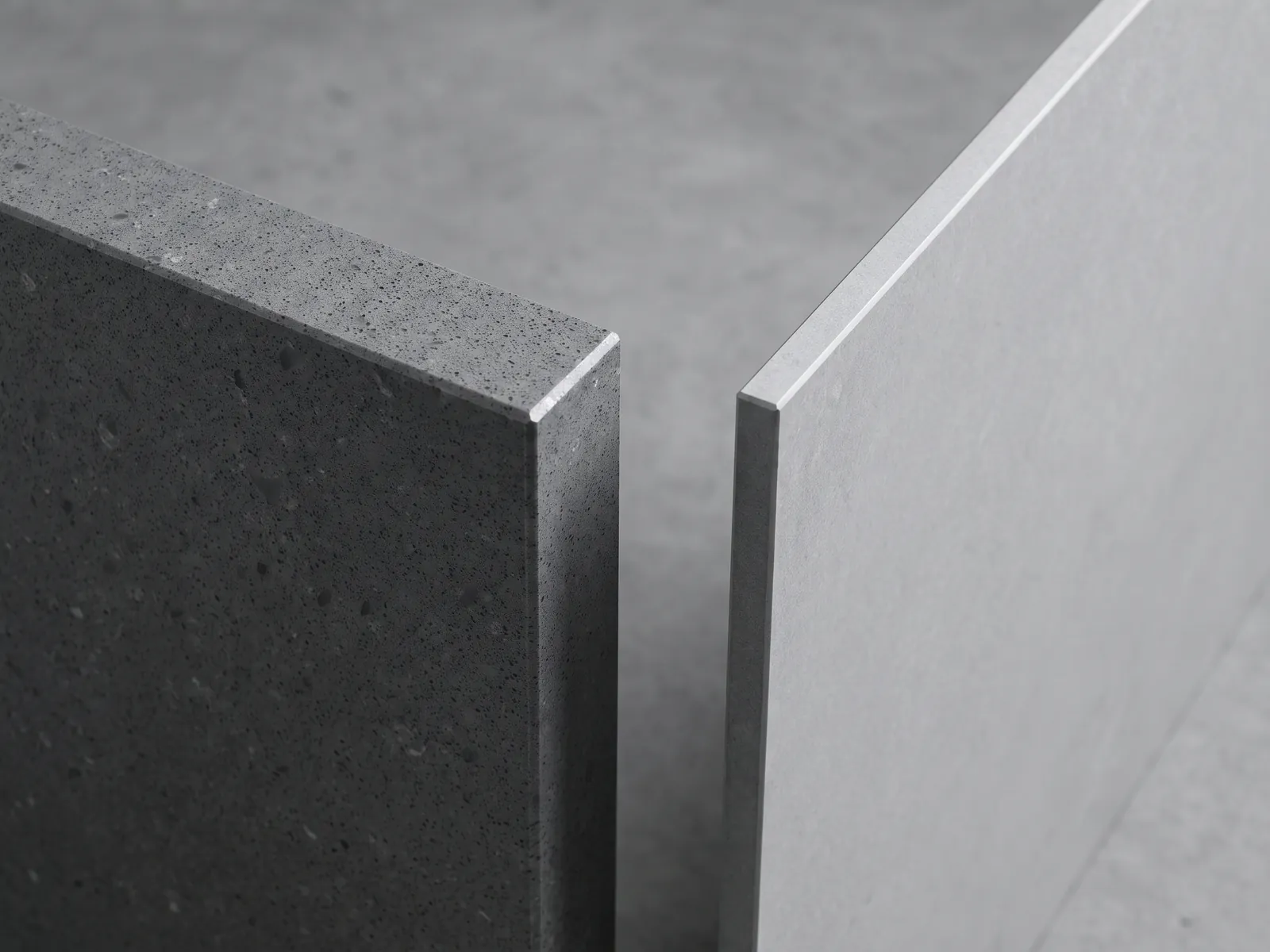
Porcelain fights its own thinness at every edge: profiles are limited, exposed edges reveal the body colour beneath the printed face, and the standard answer, mitred aprons glued to fake thickness, is skilled work with visible seam risk and fragile corners. Repairs are harsher still: a chip shows the pale body and cannot be polished away, an impact crack is a replacement panel, and refinishing is impossible because the face is a fired print. For lived-on indoor surfaces that will meet accidents, engineered stone ages like stone; porcelain ages like glass, flawless until the day it is not.
Cost and fabrication risk
As of 2026 in the UAE, the two families overlap broadly at retail, standard engineered quartz slabs supplying around AED 250 to 500 per square metre and mainstream porcelain slab work landing in a comparable territory once its fabrication joins, with designer ranges of both climbing steeply; treat figures as framing that varies by brand and fabricator. The differentiator is less the sticker than the risk profile behind it.
Porcelain's thin body is unforgiving in the shop and on site: cutouts and edge work demand specialist tooling and experience, breakage during fabrication and transport is a real cost priced into quotes, and a cracked panel after installation is a replacement, not a repair. Engineered stone is the forgiving workhorse of every fabrication shop in the Emirates, with mature tooling, predictable yields and repairable mistakes. Buyers comparing quotes should therefore weight the fabricator as much as the material, porcelain executed by specialists is excellent, porcelain by generalists is expensive roulette, and apply the same itemised-quote discipline across both families.
Choosing by application
The decision resolves cleanly by where the surface lives. Indoor kitchen worktops: engineered quartz, whose stain immunity, repairability and edge quality suit daily service, with the trivet rule as its one tax. Indoor marble looks at scale, floors, walls, vanities: engineered marble, solid and repolishable, with porcelain a competent understudy where weight or thickness constraints rule. Outdoor kitchens, barbecue counters, sun terraces: porcelain, unchallenged. Facades and ventilated cladding: porcelain's lightness is the entire point. Furniture skins and doors: porcelain again.
Bathrooms split by role, engineered stone for vanity tops that meet daily chemistry, either family on walls. High-traffic commercial floors lean to the solid materials for their refinishability, as the commercial guide details. The pattern behind the pattern: where life happens on the surface, choose solid; where sun and heat happen to it, choose fired. Both families live in the same projects comfortably, and the engineered ranges are specified alongside porcelain daily, each doing what the other cannot.
Questions, answered.
Edges and corners are its vulnerable points, especially post-fabrication. Chips expose the body colour beneath the printed face and cannot be polished out, unlike solid engineered stone.
Impressively, at viewing distance: modern printing is excellent. Up close, edges and repairs reveal the veneer, and pattern depth is where engineered marble keeps its lead.
Porcelain, decisively: UV-stable and heatproof. Engineered stone's resin limits it to indoor service.
Engineered stone: chips fill and polish invisibly because the material is solid throughout. Porcelain damage generally means panel replacement.
Global Classic Building Materials Trading LLC
Written from the Al Sajaa warehouse, Sharjah - slabs on racks, not stock photography. About the company