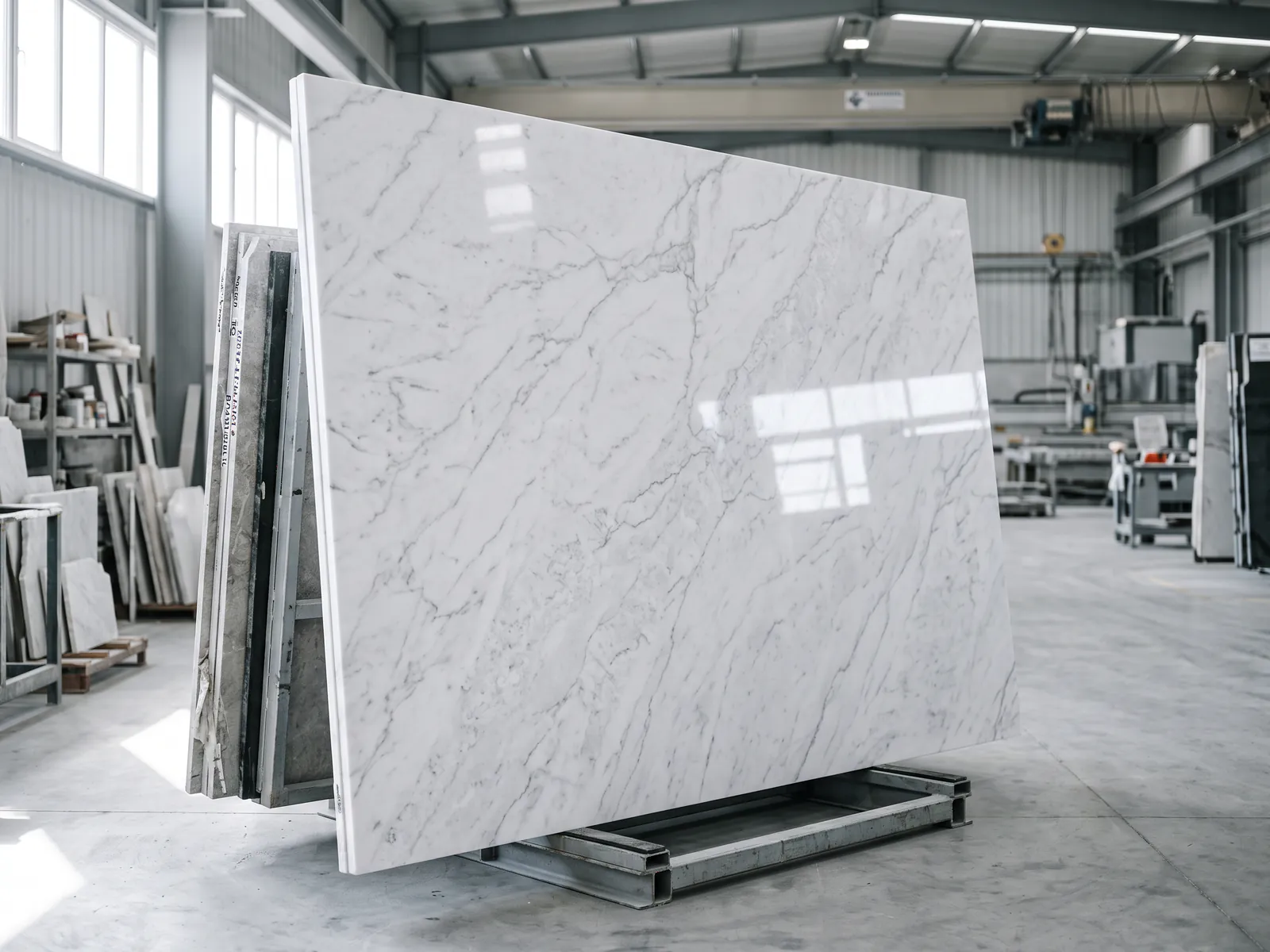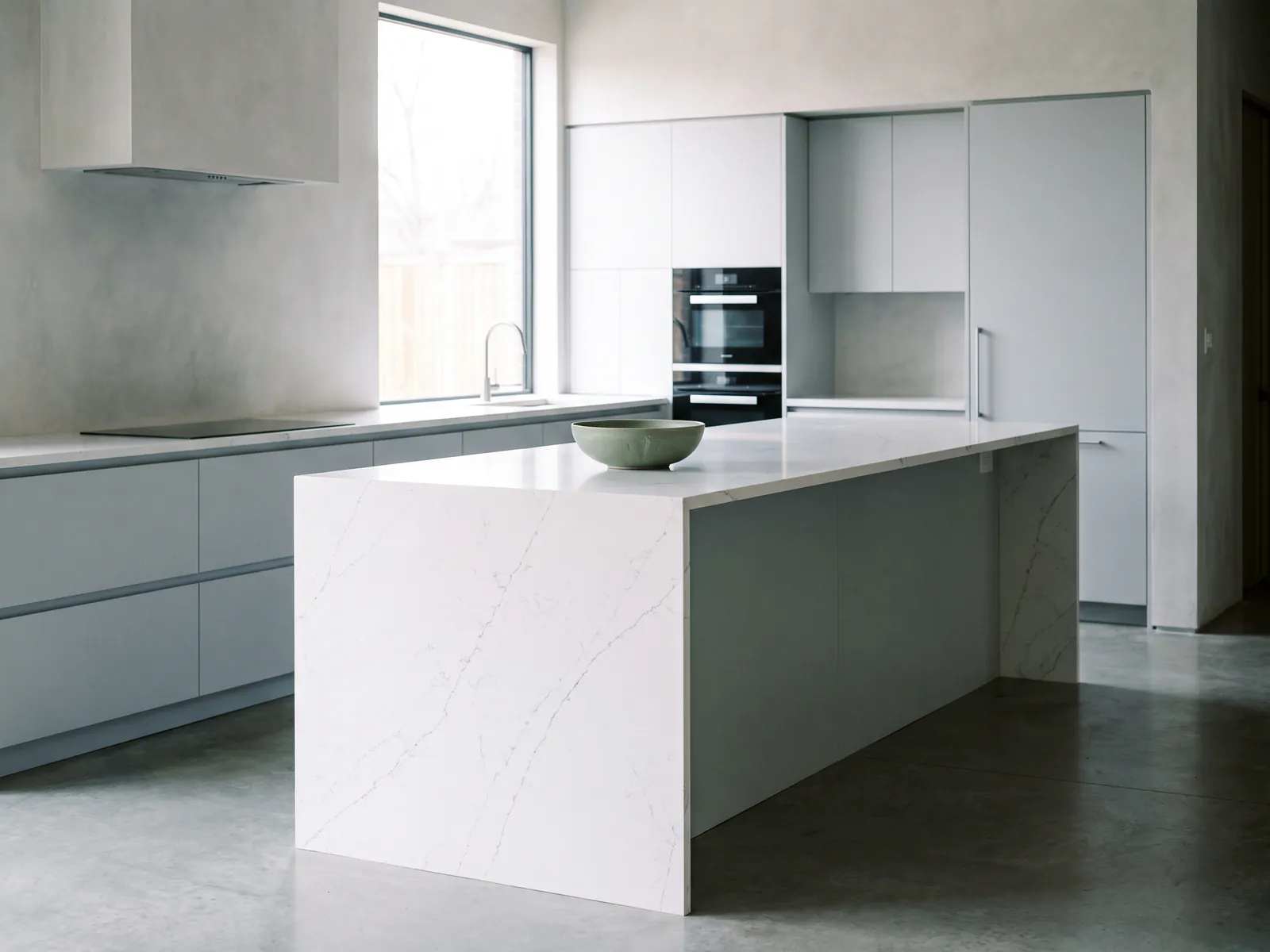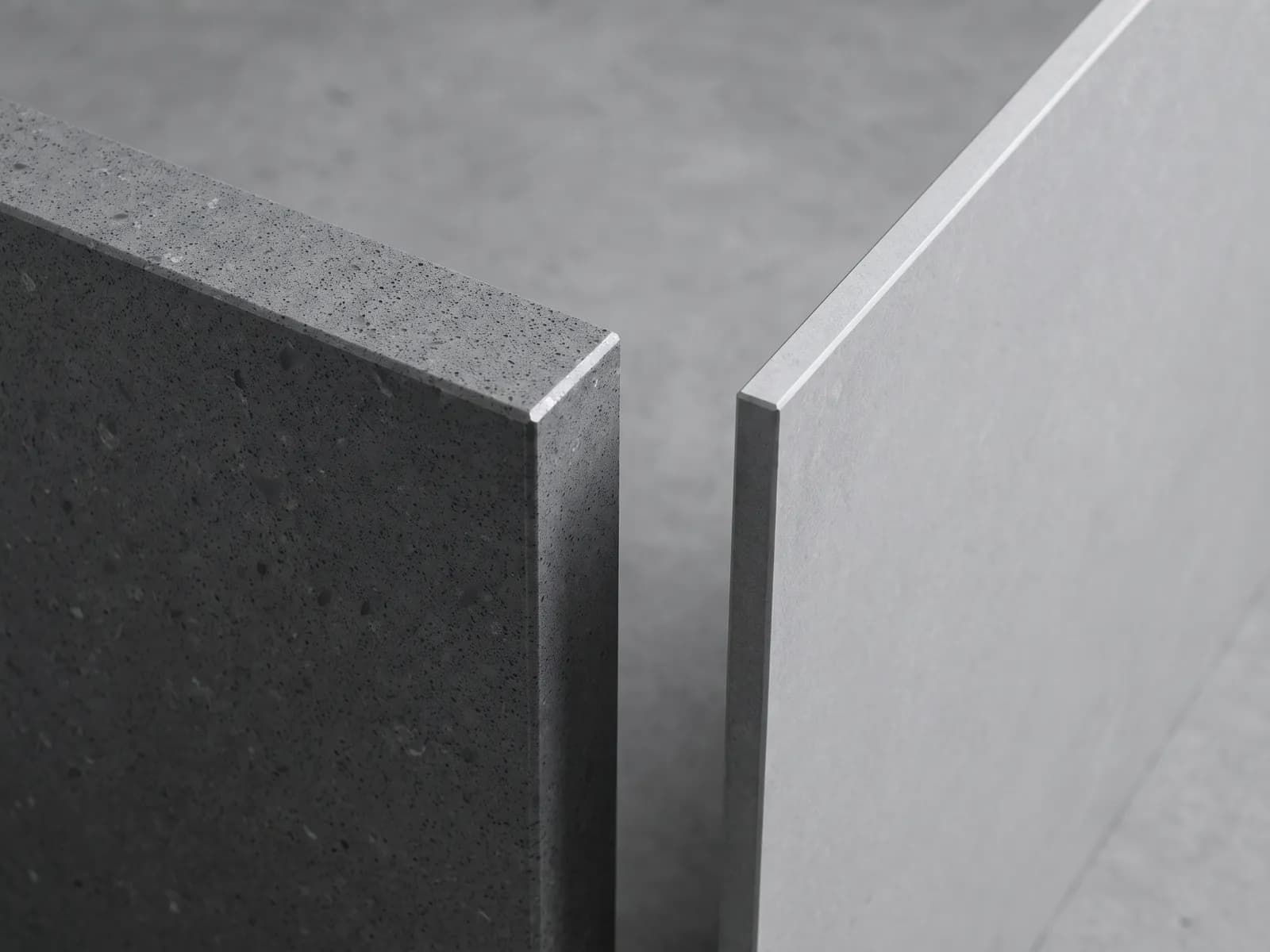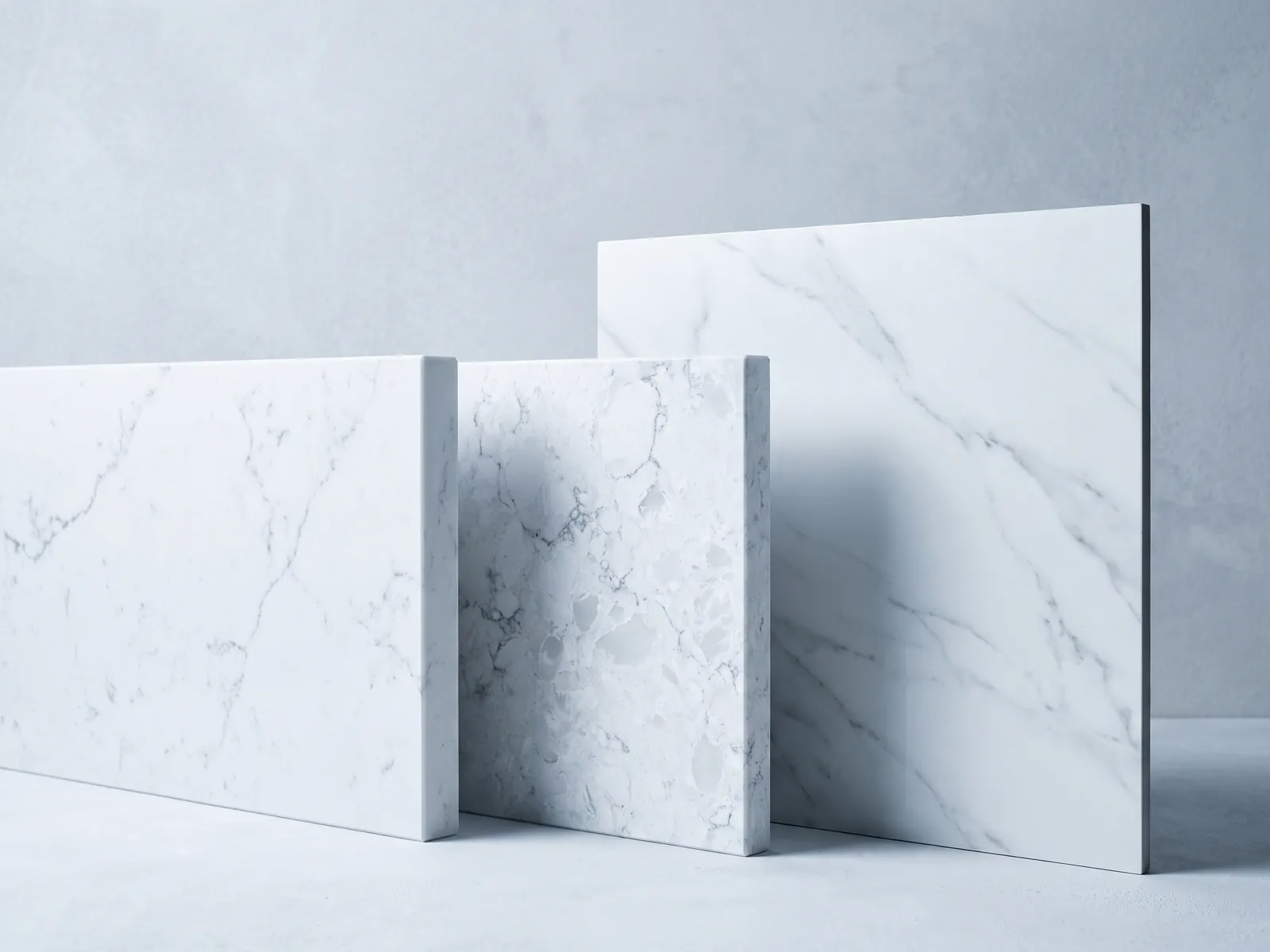
Three materials deliver marble's look without its maintenance: engineered marble, which is mostly real marble and reads truest; veined quartz, whose printed and through-body veining has closed the gap at conversation distance; and porcelain, best viewed from further away. The tell is always depth, natural veining sits in the stone, not on it, and engineered marble keeps that depth.
Ranking realism: touch, depth, light
Judge marble-look materials by the three tests eyes and hands actually run. Touch: real stone is cold, dense and takes a moment to warm under the palm; engineered marble passes identically, quartz nearly, porcelain feels thinner and warms fast. Depth: natural veining is three-dimensional mineralogy, visible slightly below the polished surface; the closer a material's pattern lives to true depth, the closer it reads at close range. Light: polished marble has a specific optical response, a soft internal glow where cheaper gloss reads as surface shine.
Run the tests and the ranking writes itself: engineered marble first, being 90-plus percent actual marble; veined quartz second, excellent at arm's length; porcelain third, calibrated for viewing distance. All three now clear the casual-glance bar easily, which is why the deciding factors are the ranges each occupies, covered material by material below, and where each will physically live, the application logic that often overrides pure realism.
Engineered marble: nearest to true
Engineered marble wins the realism contest by refusing to imitate: its body is crushed natural marble, so the colour is mineral, the coldness is mineral, and polished depth behaves like stone because it is stone, reconstituted. Veined series carry their figure through the slab, edges and cutouts reveal marble rather than a printed skin, and repolishing renews it exactly as the quarry product renews.
What manufacturing adds is the part natural stone cannot give: consistency, slab after matching slab, absorption under 0.1 percent, and pricing below the Italian stones it stands beside, as the engineered versus natural comparison details. Its boundaries remain honest, calcite content means acid etching applies, resin means hot pans are unwelcome, so the hardest-working kitchen runs still pass to quartz. For floors, walls, vanities and stairs wanting the truest marble read without the quarry's maintenance and lottery, the engineered marble range is the shortest answer this article can give.
Veined quartz: the practical double
Veined quartz is the pragmatist's marble: Calacatta-look and Carrara-look patterns engineered into a surface that then behaves nothing like marble, which is the entire point. No sealing, no etching, no staining, no anxiety, the stain and scratch record reads like marble's wish list, and the veining itself has improved generation by generation, with through-body veins in premium series carrying the figure into edges and cutouts where older prints stopped.
At conversation distance a good veined quartz convinces almost everyone; under close inspection, pattern repetition across multiple slabs and a slightly shallower depth are the remaining tells, managed by sequencing slabs thoughtfully and choosing series with generous pattern variation. Its natural home is exactly where marble's look is wanted and marble's chemistry is not: kitchen worktops above all, family bathrooms, rental stock. The white quartz families map the look's range, from whisper Carrara to theatrical Calacatta, all wipe-clean.
Porcelain: distance viewing
Porcelain slabs are printed performance: high-resolution marble imagery fired onto a dense ceramic body, with premium ranges syncing surface texture to the printed veins. Calibrated for viewing distance, a porcelain feature wall, facade or hotel corridor reads convincingly marble from metres away, and the material adds virtues no marble possesses, complete UV and heat indifference, thin lightweight formats, zero absorption.
Proximity is where the honesty surfaces: pattern repeats across panels, edges expose the body beneath the print unless mitred away, chips cannot polish out, and the glassy surface lacks stone's internal glow, the construction story the engineered versus porcelain comparison tells in full. The specification logic follows: porcelain earns the applications solid stone must refuse, outdoor kitchens, sun terraces, facades, wet-wall cladding at height, and serves budget-led marble looks where guests admire from a distance. Where hands and eyes arrive close, the solid families above repay their premium.
Cost of the look, compared
As of 2026 in Dubai, the marble look prices in overlapping bands rather than a ladder. Engineered marble supplies around AED 250 to 500 per square metre as slabs, matching the slab-grade mid-tier naturals it resembles while removing their grade lottery. Veined quartz slabs share that supply band in standard series, with designer jumbo formats above it and fabrication billed separately, fabrication-heavy pricing for fabrication-heavy applications. Marble-look porcelain spans budget tiles through premium large-format slabs whose installed cost meets quartz territory; all figures vary by grade, format and fabricator.
The sharper comparison is cost per convincing year: engineered marble and quartz repair and endure, spreading their price across decades, while damaged porcelain replaces rather than repairs, and cheap prints date fastest of all. Buyers should therefore price the application, not the aspiration, floors and walls against engineered marble, worktops against quartz, sun and facades against porcelain, and let a BOQ against real stock, quoted in AED within a working day, replace brochure arithmetic.
Questions, answered.
At room distance, almost never; up close, only trained eyes, and mainly by the engineered slab's suspicious consistency. It is mostly real marble, which is why it reads real.
Premium Calacatta-look series with through-body veining and multiple pattern variants. Judge full slabs, not sample chips, and sequence slabs to avoid visible repeats.
Budget porcelain wins the sticker contest; engineered marble wins cost-per-year for lived-on surfaces by repairing and enduring. Match the material to the application before the price.
Across multiple slabs of one design, yes, by manufacture. Good ranges offer several variants per pattern; thoughtful slab sequencing keeps repeats off adjacent surfaces.
Global Classic Building Materials Trading LLC
Written from the Al Sajaa warehouse, Sharjah - slabs on racks, not stock photography. About the company