Precast terrazzo comes as tiles for speed and budget, or large slabs for near-seamless floors with fewer joints; poured in-situ terrazzo gives a truly monolithic surface at the highest cost and longest programme. For most UAE residential and retail projects, large-format slabs hit the balance: factory consistency, fast installation, minimal joint lines.
The three formats explained
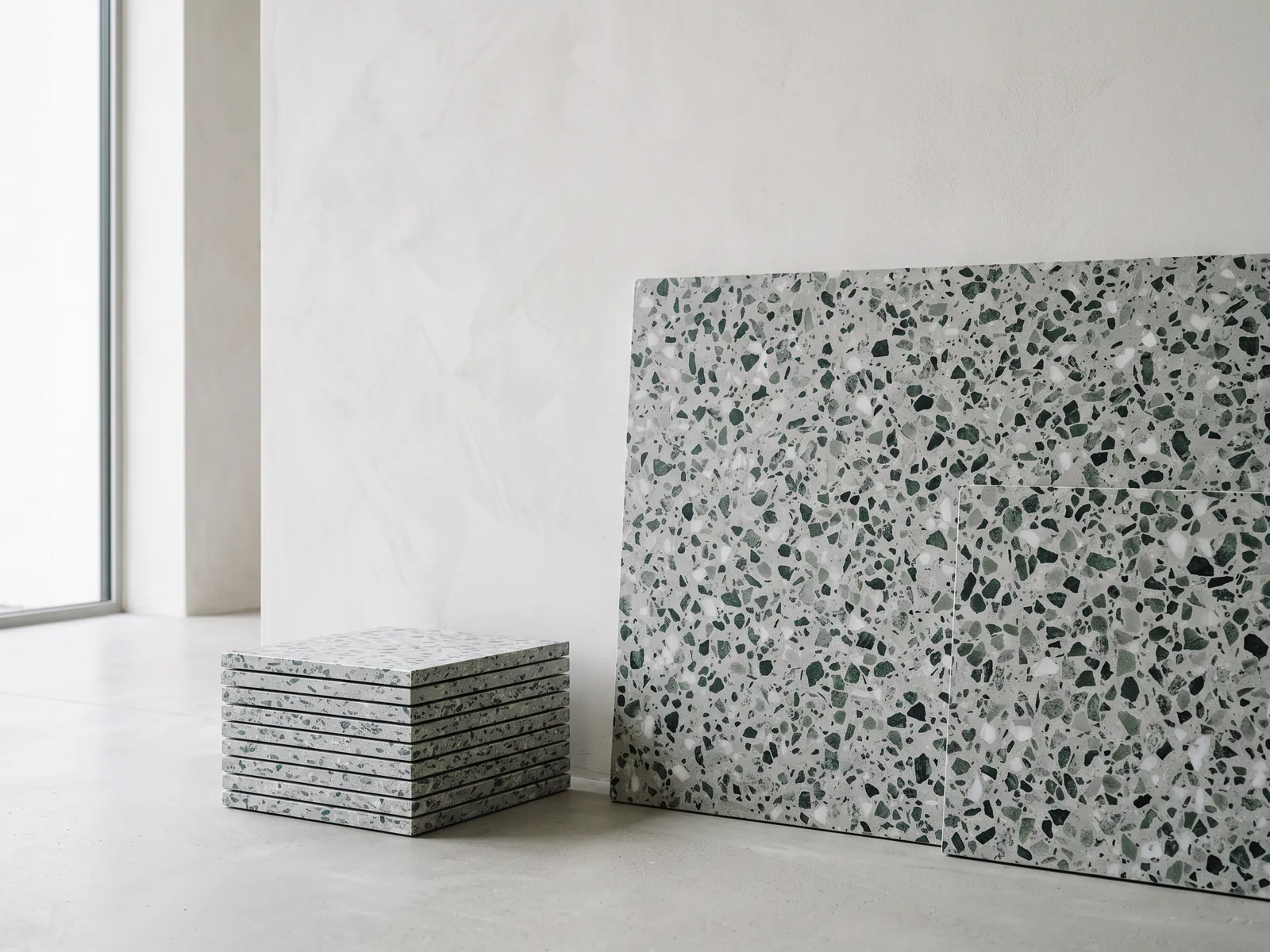
Tiles are block terrazzo sawn into modular squares and rectangles, typically 40 to 60 centimetres: they install like premium stone tile, price lowest of the three, and suit programme-driven projects where crews and methods are familiar. Slabs are the same factory block cut large, formats comparable to marble slabs, letting a floor run with a fraction of the joints and letting stairs, counters and walls cut from matching material.
Poured in-situ is the artisan original: binder and chips mixed on site, spread between divider strips, cured, then ground and polished in place over days, producing one continuous surface with no joints except the strips themselves. Each format is the same material at a different industrial moment, and the choice is really about joints, programme and money, weighed next. The terrazzo pillar guide sets the block-versus-poured history; the range itself ships as slabs and tiles across five collections.
Joints: what you'll actually see
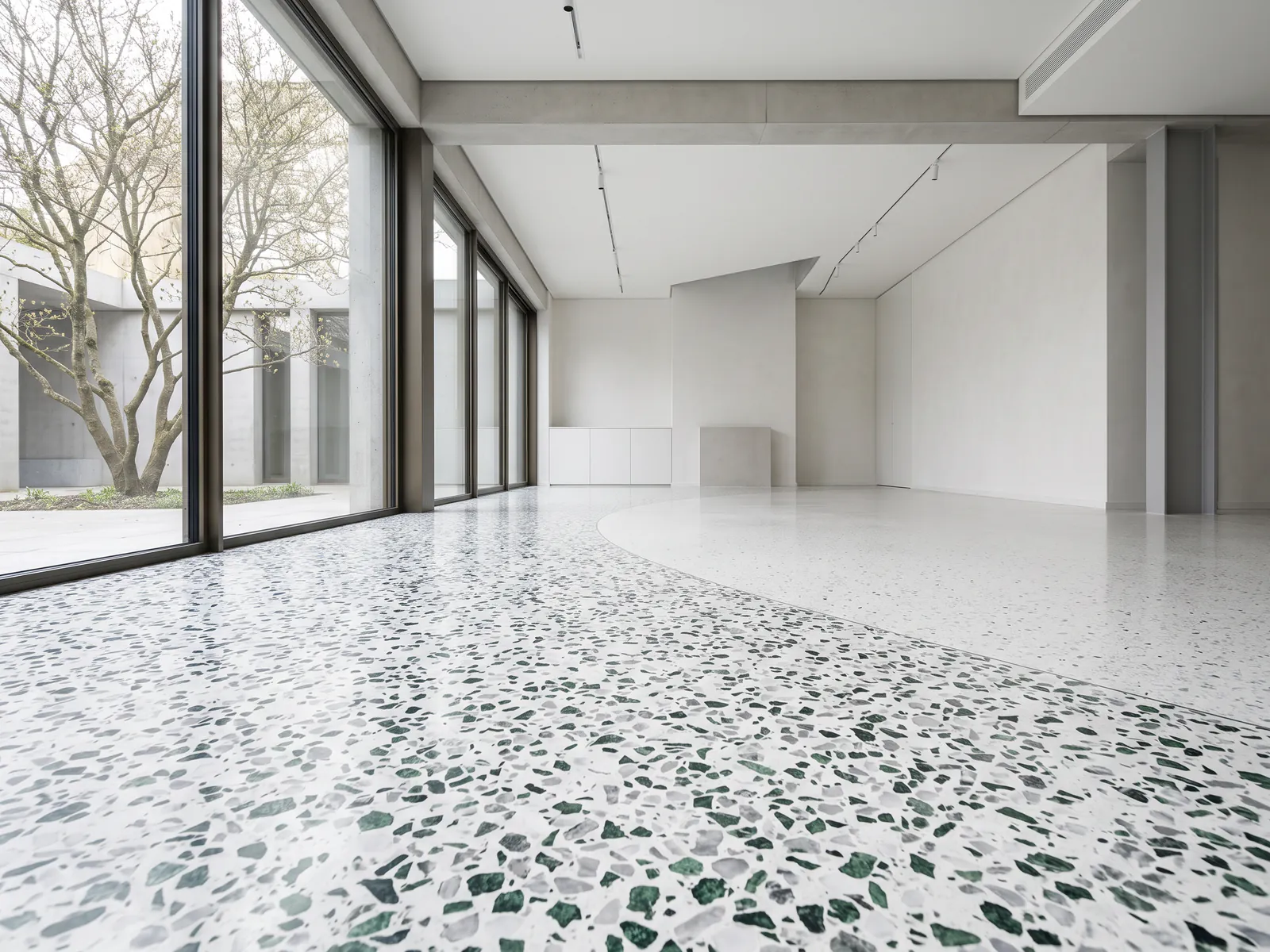
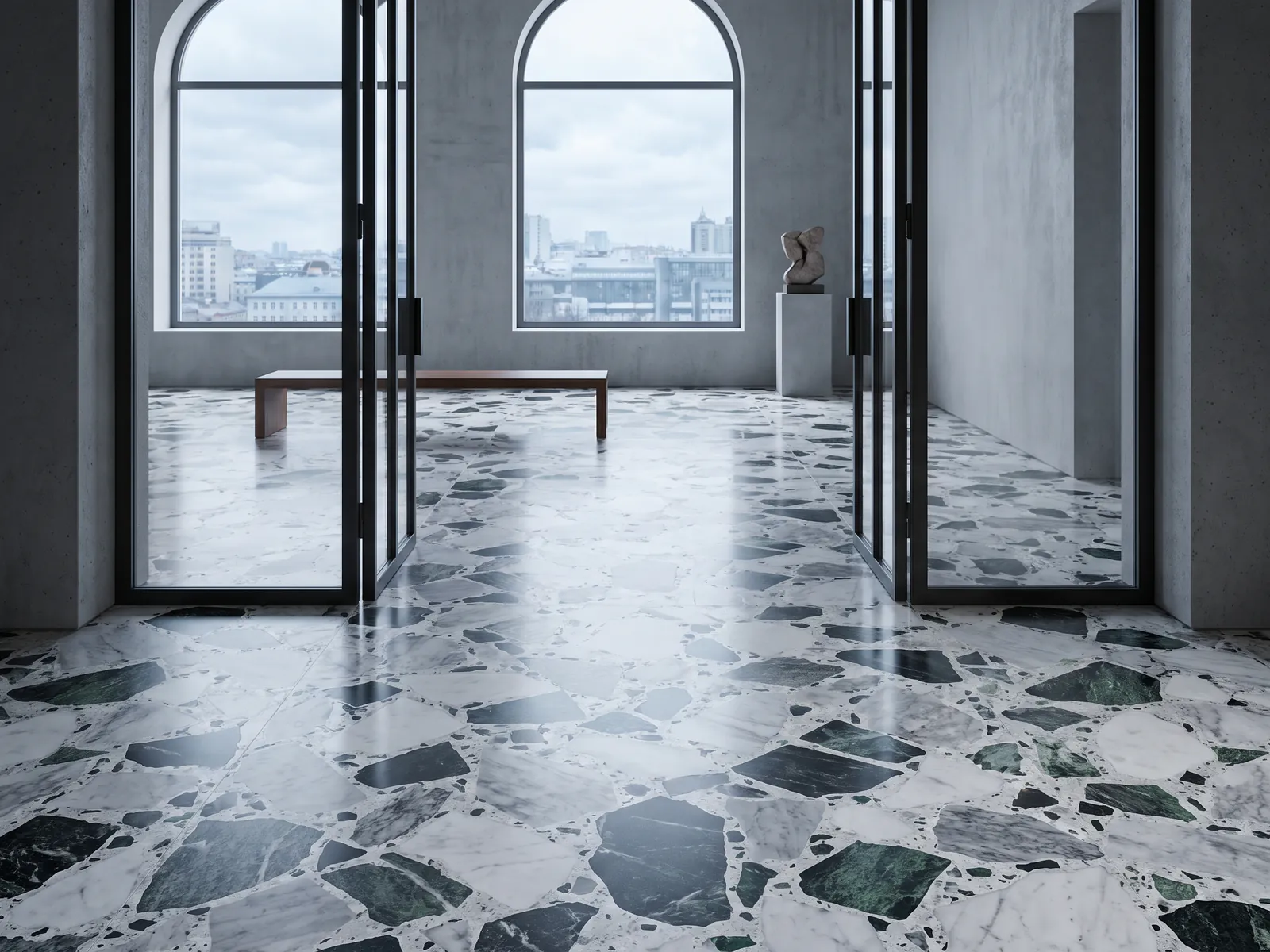
Joints are the visible difference between the formats, so picture each honestly. A tiled floor shows a grid: tight, well-laid joints read as fine lines, but they are present every half-metre, and they impose rhythm on the room. A slab floor reduces the grid to occasional lines, a large living space might carry only a handful, and at conversation distance it reads as continuous stone; this is the near-seamless middle ground.
A poured floor has no cut joints at all, only the metal or brass divider strips placed for expansion and pattern, which many designs celebrate as drawn lines. Two practical notes: joint visibility depends as much on grout colour discipline, matched tight joints disappear, contrasting ones advertise, and on lighting, since long raking light finds every line. And terrazzo's pattern helps: the chip field distracts the eye from joints far better than plain porcelain does, which is why even tiled terrazzo reads calmer than its grid suggests.
Programme and cost compared
Ranked by installed cost and time on site, tiles come first: standard stone-fixing rates, familiar crews, floors walkable in days, and as of 2026 the most budget-predictable route into terrazzo. Slabs run modestly higher, larger pieces demand defter handling and flatter screeds, but installation remains conventional and fast, and the premium buys the joint reduction above. Poured in-situ stands apart: skilled specialist crews, wet-trade programme measured in weeks, on-site grinding and polishing with its dust and logistics, and costs typically well above both precast routes; all figures vary by project, so price the specific scope.
Programme risk follows the same order: precast arrives finished, its quality set in the factory before a truck moves, while poured quality is made on your site, weather, crew and cure all included. For UAE fit-outs on commercial timelines, that risk profile, more than money, is what has moved the market to block formats.
Curved and custom work
Custom geometry redistributes the advantages. Poured terrazzo is the native medium for curves: sweeping reception desks, radiused stair flights, floors that flow around columns, the material is shaped wet, so geometry costs design rather than fabrication. Slabs handle curves the way stone does, CNC-cut to templates, with gentle radii and curved edges entirely achievable from large formats, at fabrication cost and with joints where pieces meet; tiles manage faceted approximations only.
Custom extends beyond curves: block terrazzo turns into solid stair treads, counters, basins, benches and furniture, cut and polished like quarried stone, which poured floors cannot become. Bespoke chip-and-colour recipes exist at both ends, in the factory for block runs at quantity, on site for poured work. The practical guidance: one dramatic curved element in a precast project is a fabrication exercise; an architecture of continuous curves is a poured commission. Most UAE projects are the former, which keeps them in the slab economy.
Matching stairs, skirting and walls
A terrazzo floor becomes a terrazzo architecture when the material climbs: stairs cut as solid treads and risers from the same block, skirting run in matching strips instead of paint, walls clad in slab panels, counters and window sills joining the family. This is block terrazzo's quiet superpower, since every element saws from the same factory batch, chips and tone identical, something a poured floor cannot extend and a tile range may not offer beyond its modules.
Specify the whole family from one batch at order time: stair treads with anti-slip detailing, skirting heights, wall panel formats, and any counters, because matching a later batch is never guaranteed. Design-wise, continuity rewards restraint elsewhere, one material carried floor-to-wall wants calm furniture and few competing stones. For the vertical showpiece, fluted terrazzo panels groove the same material for feature walls, the signature move covered further in the 2026 design directions.
Questions, answered.
Near-seamless, with discipline: tight joints, grout matched to the ground colour, and larger modules. True seamlessness belongs to slabs and poured floors, but well-laid tiles come surprisingly close.
For curved architecture and truly monolithic surfaces at generous budgets, yes. For typical UAE rooms and timelines, block slabs deliver most of the look at a fraction of the programme and risk.
Comparable to stone slabs, with large formats that cut to oversized floor modules, stair treads and wall panels. Confirm per collection before design freezes.
Excellently: solid treads and risers cut from block match the floor exactly, with anti-slip grooves or inserts specified for the nosing.
Global Classic Building Materials Trading LLC
Written from the Al Sajaa warehouse, Sharjah - slabs on racks, not stock photography. About the company