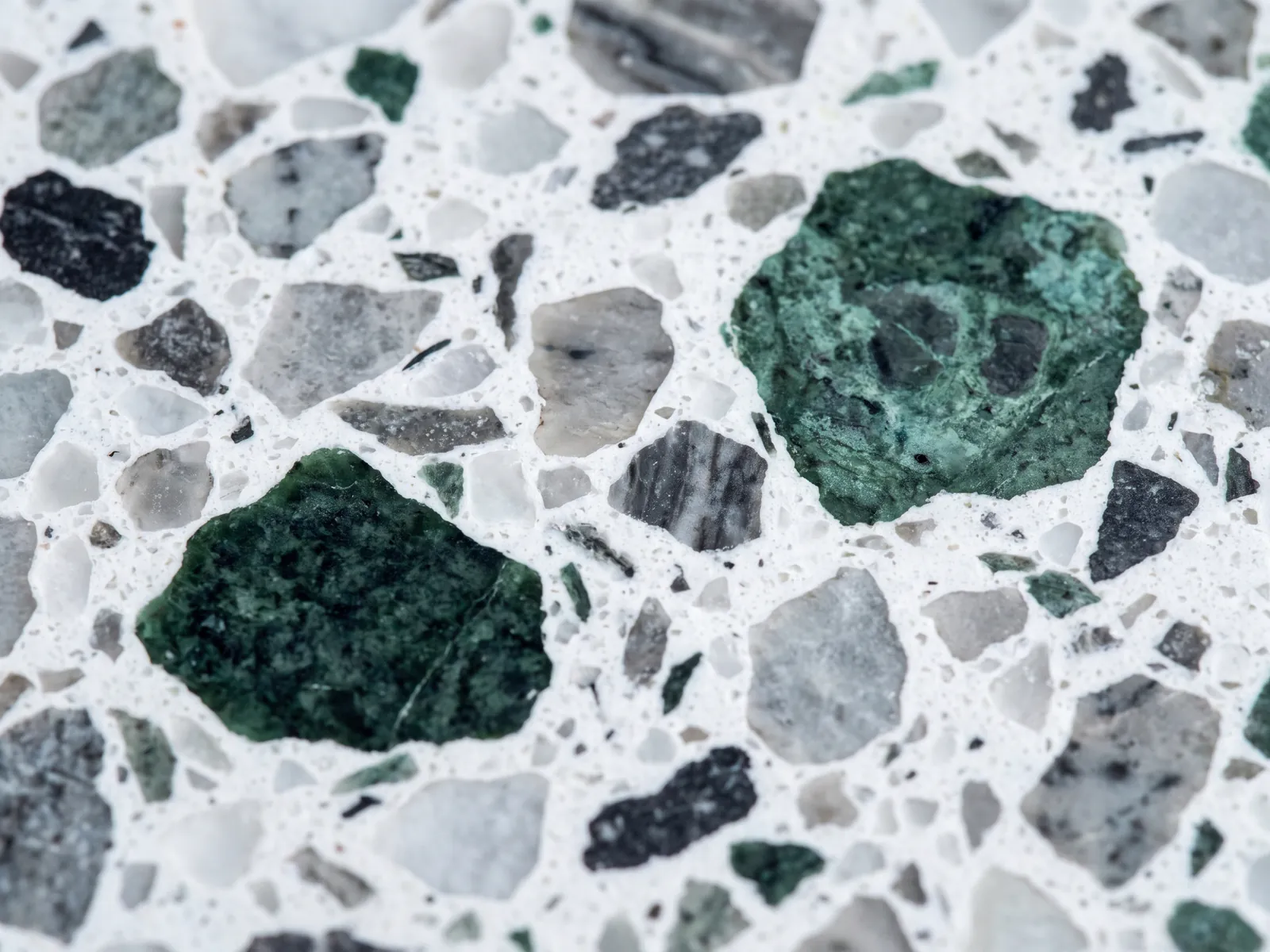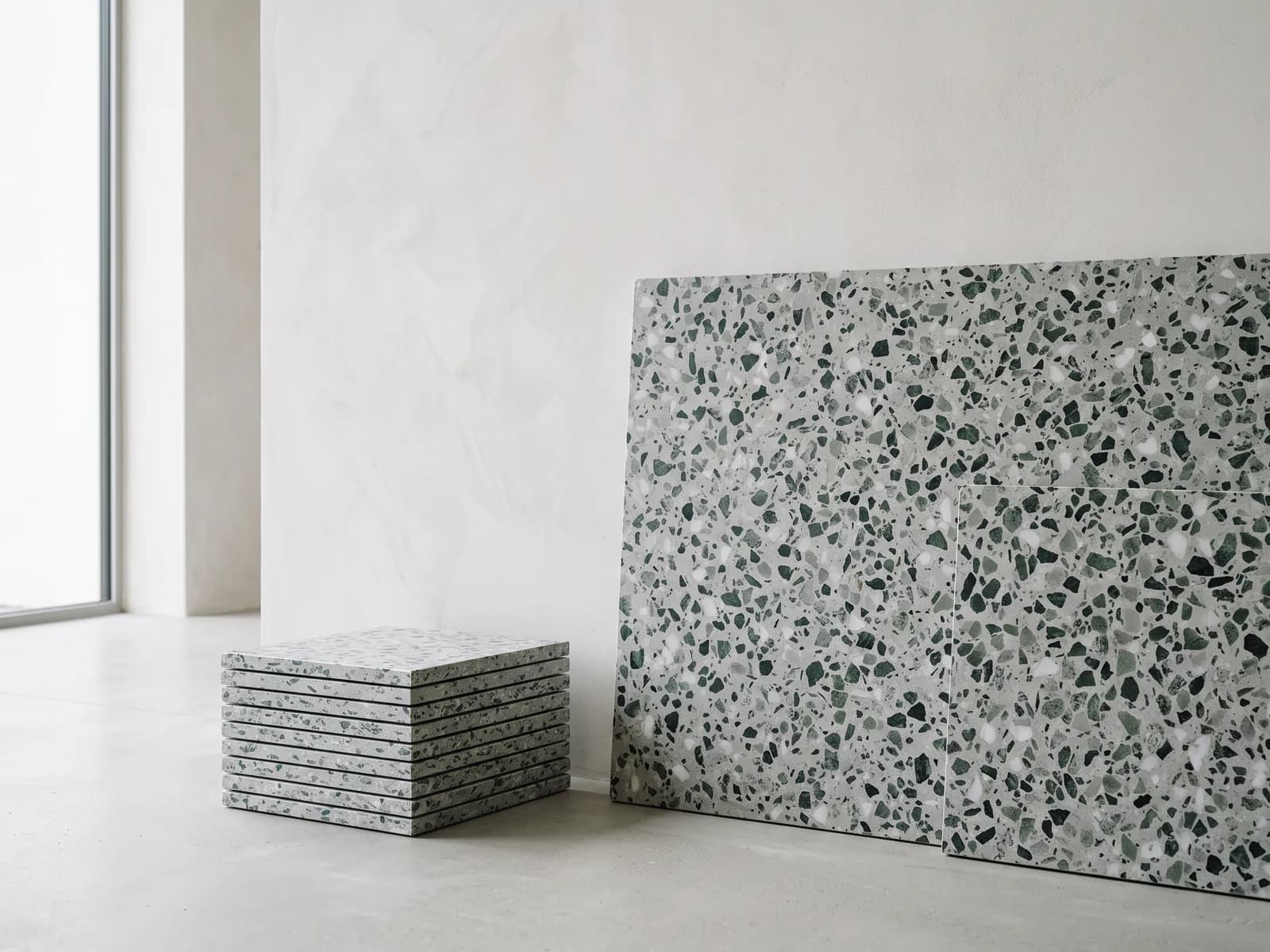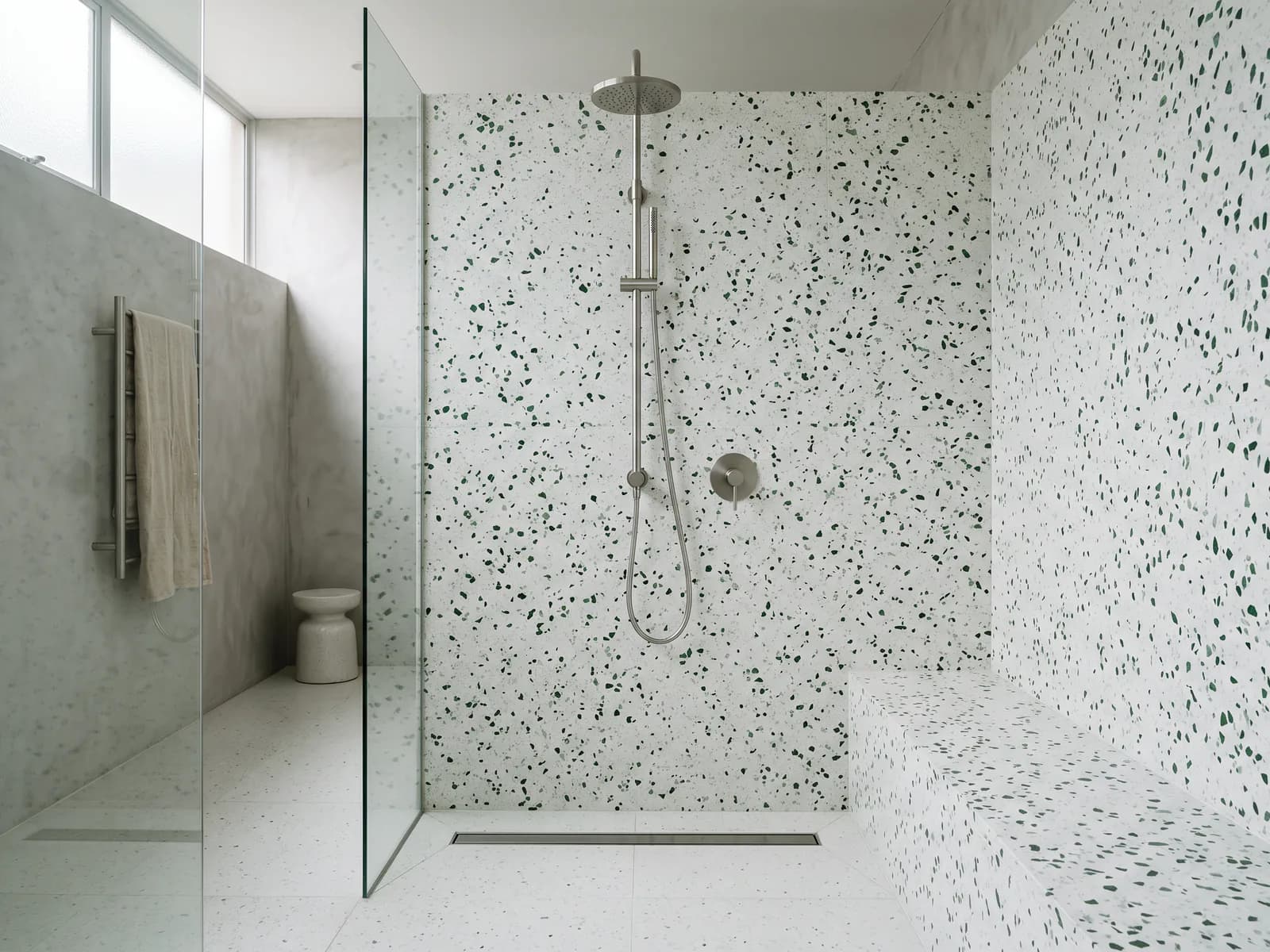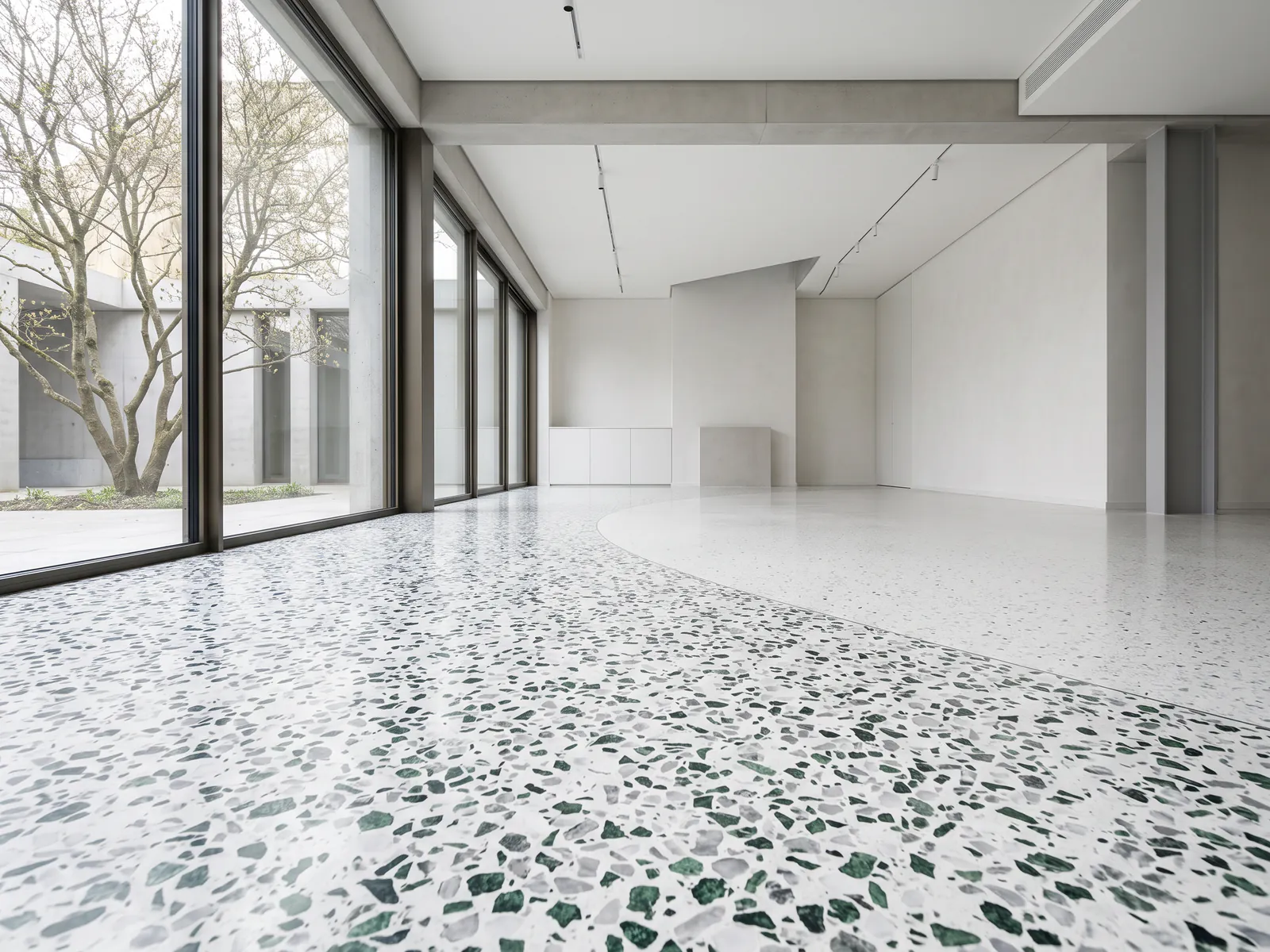
Terrazzo is a composite of marble, granite or glass chips set in a cement or resin binder, ground and polished to a flat, seamless surface. Modern block terrazzo is factory-made into slabs and tiles, which install faster and more consistently than site-poured floors. Its hardness, low water absorption and repairability make it one of the most durable floor finishes available for UAE homes and commercial spaces.
How terrazzo is made: poured vs precast block
Terrazzo comes into a building two ways. Poured in-situ terrazzo is the historic method: chips and binder are mixed on site, spread between divider strips, then ground and polished in place over days. Precast block terrazzo inverts this: the material is cast as large factory blocks, cured under controlled conditions, then sawn into slabs and tiles the way quarried stone is, arriving finished and calibrated.
The factory route is why terrazzo has returned to serious specification in the UAE. Block production controls chip distribution, cure and calibration in ways a site never can, so every tile from a batch matches, and installation runs at stone-fixing speed instead of wet-trade programme. KalingaStone terrazzo is block terrazzo across five collections, cut into slab and tile formats with matching stair treads and skirting, which is what lets a whole villa read as one continuous material.
Terrazzo pros and cons, honestly
The honest ledger: terrazzo's advantages are durability measured in decades, seamless coverage over large areas, a design range no natural stone matches, effortless cleaning and full repairability, chips and dulling grind out invisibly. Its drawbacks are a higher upfront cost than porcelain, hardness underfoot that some households find unforgiving, coolness without underfloor heating, and slipperiness in polished finishes when wet.
The drawbacks all have management strategies: honed and river-wash finishes for wet and barefoot zones, rugs where standing comfort matters, and lifecycle arithmetic for the price question, since a floor that outlives three porcelain replacements is not actually the expensive option. What it genuinely is not: a floor for owners planning to sell in two years, where the premium never pays back. The full pros and cons breakdown takes each claim apart in detail.
Is terrazzo good for UAE homes?
Terrazzo suits UAE homes unusually well, for two climate reasons and one household one. Thermal mass first: a dense mineral floor holds the coolness that air conditioning produces, staying pleasantly cold underfoot through summer in a way timber and vinyl never do. Sand second: the Gulf's fine airborne grit is the great enemy of polished floors, and terrazzo's mineral chips resist that abrasion far better than softer marbles, while honed finishes disguise the micro-scratching that traffic brings.
The household reason is maintenance reality: terrazzo asks for a dust mop and a neutral cleaner, nothing else, and shrugs off the spills, pets and children that stain porous stone. Villas with courtyards and pool surrounds should specify river-wash or honed textures outside for grip. The one caution: ground-floor slabs over unconditioned voids can feel cold in the brief winter, which is either a feature or a rug, depending on the room.
Terrazzo cost in Dubai vs marble and porcelain
As of 2026, block terrazzo in Dubai supplies at roughly AED 250 to 500 per square metre as slabs and tiles depending on collection and format, with statement large-chip collections toward the top and fixing priced separately against the laying spec. Porcelain runs cheaper to buy and install; natural marble overlaps terrazzo's band and rises far beyond it. All figures vary by project and supplier; treat them as ranges to frame quotes, not quotes.
The number that matters is lifecycle cost. Terrazzo's service life runs decades with repolishing, where porcelain is replaced when fashion or chips demand and cannot be refinished. Across a twenty-year hold, terrazzo frequently comes out the cheapest floor in the comparison. For BOQ-scale pricing against live stock, the terrazzo range is quoted in AED from Al Sajaa, usually within one working day.
Finishes: polished, honed, river wash, fluted
Four finishes cover terrazzo's range. Polished is the classic mirror surface, richest colour and highest maintenance visibility; it belongs in interiors away from standing water. Honed is the satin workhorse: lower glare, better grip, forgiving of sand scratching, the default for UAE family floors. River wash exposes the chips in gentle relief for genuine wet-area and exterior traction, pool surrounds and terraces. And fluting carries terrazzo onto the wall: grooved panels that turn the material into architecture, catching light along every ridge.
Finish is also a zoning tool: the same collection can run polished through a majlis, honed through bedrooms and river-washed onto the terrace, one palette with three behaviours. The fluted terrazzo panels are the range's signature, a wall treatment none of the porcelain imitators offer, and the raking-light play on the fluting page shows exactly why.
Design: from minimal Roma palettes to statement Elite chips
Terrazzo design now spans two temperaments. At the quiet end sit tonal micro-chip surfaces, the Roma direction, where fine aggregate in near-monochrome palettes reads almost as solid stone at distance and gains texture up close; these floors serve minimal interiors that want warmth without pattern. At the loud end sit large-chip statement surfaces, the Elite direction, where oversized marble fragments in contrasting colours make the floor the room's protagonist.
Between them run cafe-culture mid-scale mixes and the Palladiana approach of irregular slab fragments. The specifier's rule: chip scale should match viewing distance and room size, small chips for small rooms and close viewing, bold chips for lobbies and long sightlines. Colour behaves the same way, greys and creams recede, greens and blacks declare themselves. The 2026 design directions piece maps where the material is heading, including terrazzo furniture and objects.
Questions, answered.
Upfront it costs more than porcelain, roughly AED 250 to 500 per square metre supply-only in Dubai as of 2026, with fixing priced separately. Over a decades-long service life with repolishing, it is often the cheapest floor per year of use.
Polished terrazzo is slippery when wet, like any polished stone. Honed and river-wash finishes restore grip and are the correct specification for bathrooms, pool surrounds and exterior steps.
Block terrazzo on a properly prepared substrate very rarely cracks; historic cracking belongs to site-poured floors over moving slabs. Movement joints and correct adhesives are the insurance.
Yes. Slab terrazzo clads walls, counters and stairs, and fluted terrazzo panels are specifically a wall treatment, grooved for shadow play in feature walls and reception backdrops.
The opposite: block production, big-chip palettes and fluting have made it one of the most specified materials in current UAE hospitality and residential design. What dated was 1970s beige, not the material.
Global Classic Building Materials Trading LLC
Written from the Al Sajaa warehouse, Sharjah - slabs on racks, not stock photography. About the company