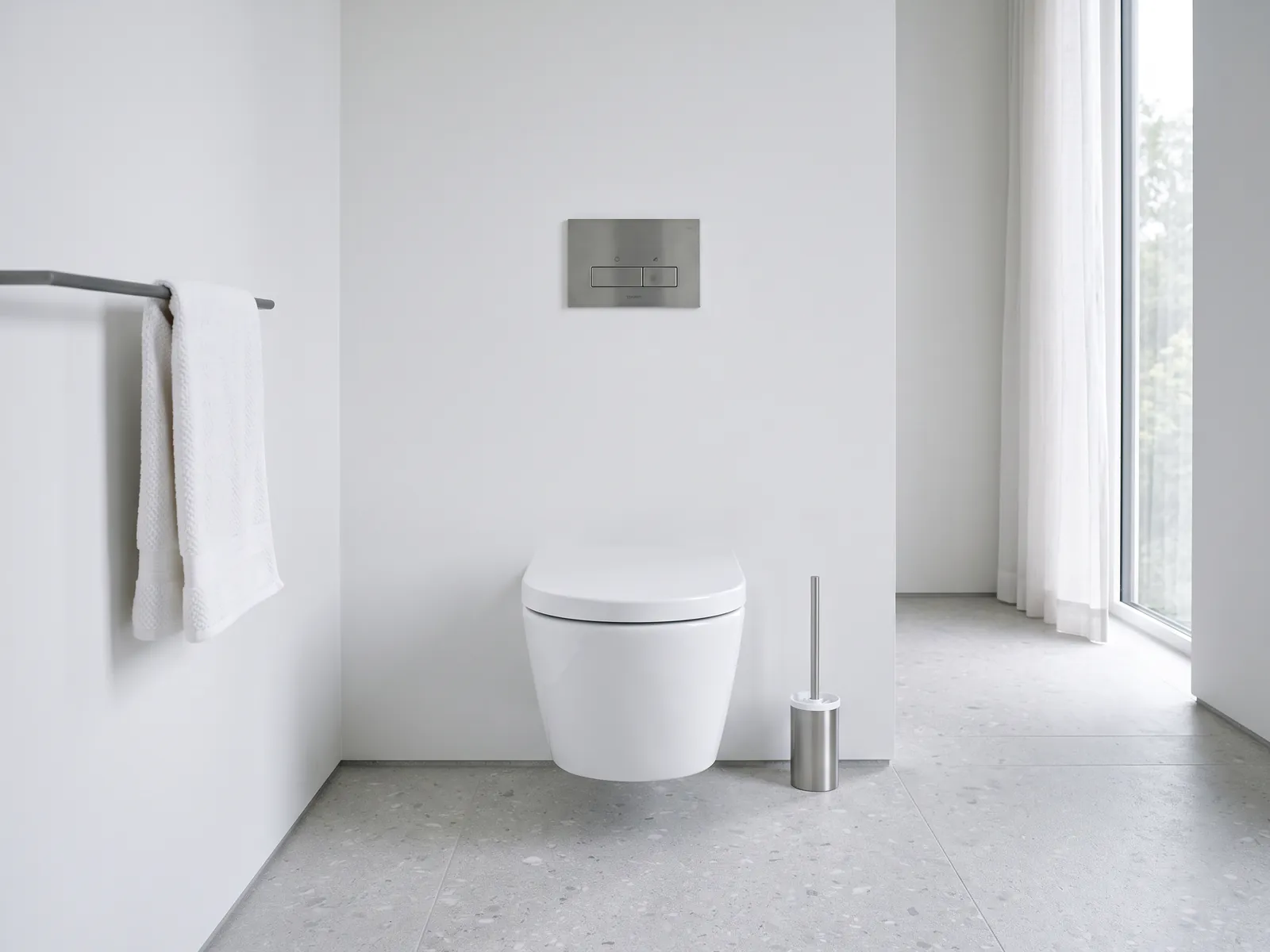
Wall-hung toilets win on cleaning and looks, the floor runs clear beneath them, but cost more and require a concealed cistern frame inside the wall. Floor-mounted units are cheaper, simpler and serviceable anywhere. In UAE new builds and renovations with wall depth to spare, wall-hung is worth it; in quick refits, floor-mount stays sensible.
Cleaning and the floating look
The wall-hung argument starts at floor level: with the bowl cantilevered off the wall and the cistern hidden inside it, the floor runs uninterrupted beneath, no pedestal foot, no silicone ring collecting grime, no awkward mop geometry. Cleaning a wall-hung bathroom is one straight pass, which in fine-dust country, where floors want frequent mopping anyway, is a daily dividend rather than a showroom line.
The floating look carries the same logic upward: less visible mass, more visible floor, and small bathrooms read distinctly larger for it, the effect the small bathroom guide builds on. Height flexibility is the quiet third benefit, the frame sets the bowl at any height during installation, comfortable for tall households and accessibility needs alike. Floor-mounted units answer with modern back-to-wall designs that hide pipework and shrink the pedestal, closing much of the visual gap at less cost, though the mop still navigates around them.
The concealed frame: what's in your wall
A wall-hung WC hangs on a galvanised steel frame anchored to the structure, carrying a plastic cistern, the flush mechanism and the drainage connection, all buried in a false wall or chase typically 15 to 20 centimetres deep and finished with tiles and a flush plate. The frame is load-rated engineering, quality systems carry 400 kilograms, and its brand matters more than the ceramic's, because it is the part you cannot easily revisit.
Planning realities follow: the wall needs the depth, solid-block UAE walls chase or gain a plasterboard liner; drainage must reach the new outlet height; and the decision belongs to renovation stage, never after tiling. Buy the frame and ceramic as a matched, warrantied pair from a brand with local spares, since a discontinued flush mechanism inside a tiled wall is the failure mode to design against, the exact argument the brand tier guide makes for concealed anything. Done once, properly, the wall forgets the frame is there.
Weight and reliability myths
Two fears follow wall-hung toilets, and both dissolve on inspection. Weight: the image of ceramic tearing off a wall belongs to bad installation, not the technology; rated frames carry 400 kilograms, several adults' worth, and transfer load to floor and structure, not tiles. The failure stories trace to frames skipped, anchored into hollow partition without reinforcement, or bought unbranded, installation sins with floor-mounted equivalents of their own.
Reliability: the concealed cistern is the same humble float-and-flush hardware as any exposed cistern, no more prone to failure for being hidden, and quality systems design every serviceable part to extract through the flush-plate opening, no tiles harmed. What genuinely differs is consequence: a botched cheap concealed system is costlier to reach than a botched pedestal, which is an argument for buying well, not for avoiding the format. Specify a rated frame, a brand with UAE spares, and a plumber who has installed dozens, and the myths stay myths.
Cost difference, installed
Expect the wall-hung route to cost meaningfully more installed, and know where the money goes. The ceramic itself prices similarly across formats; the gap lives in the frame system, the false-wall or chasing work, waterproofing and re-tiling around it, and longer installation. As of 2026 in the UAE, the all-in premium over a comparable floor-mounted installation commonly lands in the low-to-mid four figures in dirhams per bathroom, varying with wall construction and tile choices; treat the figure as framing and get itemised quotes.
Context matters: inside a full renovation, where walls and tiling are open anyway, the increment shrinks to frame-plus-ceramic and is at its cheapest; as a standalone swap it is at its most expensive and least sensible. Floor-mounted back-to-wall designs, sitting between formats in look and price, deserve a line in any comparison. Multiply thoughtfully at project scale, forty bathrooms feel this decision, which is where the fittings buyer's guide frames the whole-bathroom budget.
Rimless flushing: have it either way
Whatever the mounting, specify rimless. Traditional bowls flush through a hollow rim whose underside no brush truly reaches, the bathroom's least defensible hiding place; rimless bowls delete the channel and sweep the open bowl with a directed flush, so cleaning is visible, quick and honest. In hard-water country the argument doubles: scale colonises hidden rims first, while rimless surfaces wipe clear before deposits root.
Rimless is a bowl design, not a mounting feature, and every serious range now offers it in both wall-hung and floor-mounted formats, so it should be a default line in any specification rather than an upgrade decision. Pair it with the other modern defaults, dual flush for water sense, soft-close quick-release seats that lift off for cleaning, and appropriate glaze technology, and either mounting delivers a genuinely low-maintenance WC. The Jaquar sanitaryware ranges run rimless across both formats with the frames and flush plates to match either answer.
Questions, answered.
Not when installed on a rated frame anchored properly: systems carry 400 kilograms by design. Failure stories trace to skipped or unbranded frames, not the format.
Most, with the right approach: solid walls chase or take a lined frame; partitions need the load carried by the frame to the floor. Wall depth of 15 to 20 centimetres is the practical requirement.
Through the flush plate opening: quality systems extract every serviceable component that way, no tile removal. This is why frame brand and spares availability matter most.
A bowl without the hollow flush rim: water sweeps an open bowl instead, leaving nowhere hidden for grime or scale. Specify it regardless of mounting.
Global Classic Building Materials Trading LLC
Written from the Al Sajaa warehouse, Sharjah - slabs on racks, not stock photography. About the company